Aluminum Machining with Carbide Tools: Avoid Built-up Edge
Full Article Structure
1. Why Aluminum Sticks to Carbide Inserts
Aluminum alloys have high ductility and low melting point. Under strong cutting pressure, aluminum material welds onto the cutting edge and forms built-up edge. BUE ruins surface finish, causes dimensional drift and scratches the finished surface.
2. Carbide Grade & Coating Selection for Al
- Uncoated ultra-fine grain carbide is the top choice for aluminum, low friction, anti-adhesion
- If coating is required, choose smooth DLC coating; avoid TiN / TiAlN, easy to stick aluminum
- High silicon aluminum: more abrasive, select wear-resistant fine grain substrate
3. Cutting Parameters for 6061 & 7075
| Material | Process | Cutting Speed (m/min) | Feed (mm/r) |
|---|---|---|---|
| 6061 Aluminum | Finishing Turning | 800–1500 | 0.08–0.18 |
| 6061 Aluminum | Rough Turning | 600–1000 | 0.20–0.40 |
| 7075 High Strength Al | Turning | 500–900 | 0.10–0.25 |
4. Edge Hone & Chipbreaker Design
Aluminum machining prefers sharp edge with minimal hone. Large positive rake and open, curved chipbreaker help chips flow away quickly. Closed chipbreaker is easy to trap aluminum and trigger BUE. Use big nose radius for mirror finishing.
5. Coolant & Operation Tips to Stop BUE
Aluminum cutting needs good lubrication, not just cooling. Use oil-based cutting fluid or alcohol additive. Direct coolant jet to the cutting edge. Keep stable high speed; too low speed is the main cause of built-up edge on aluminum parts.
6. Summary
The core of aluminum machining is anti-adhesion. Uncoated ultra-fine grain carbide, sharp edge, open chipbreaker, high cutting speed and good lubrication together eliminate built-up edge and achieve bright, scratch-free aluminum surface.
Share your aluminum grade (6061/7075/A380), turning or milling, we recommend anti-BUE carbide inserts and parameters for your aluminum parts.
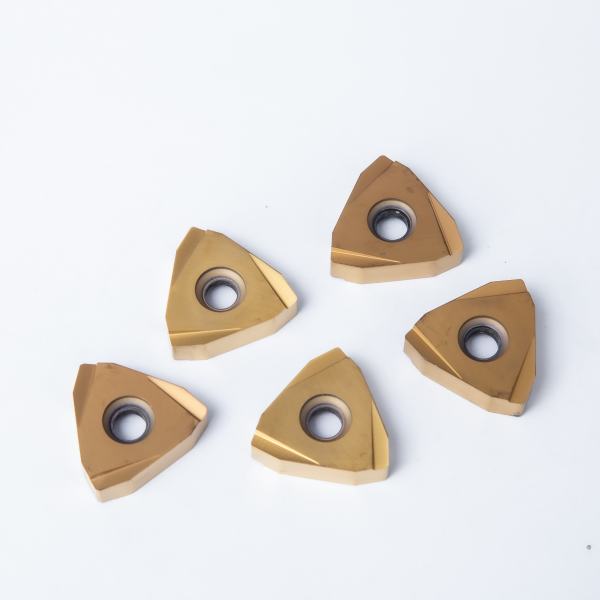
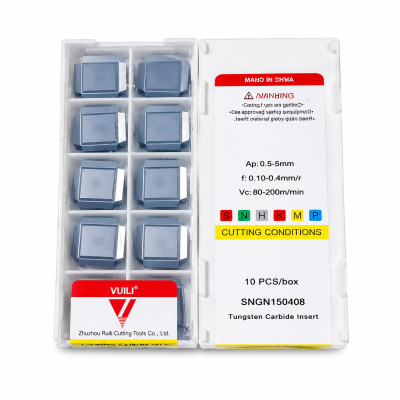
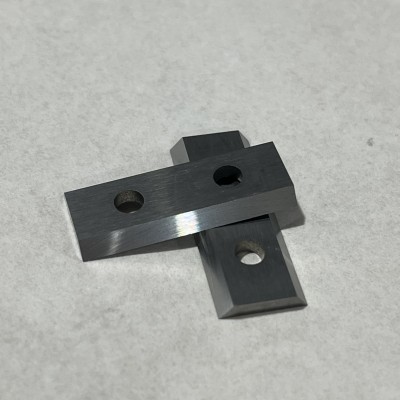
Anti built-up edge carbide inserts for 6061,7075, cast aluminum, widely used for automotive and electronics aluminum components.